Disclosure: This article contains an affiliate recommendation. If you purchase Fetra AI through our link, we may earn a commission at no additional cost to you. Our recommendations are based on the workflow, features, and considerations discussed in this guide.
Quick Answer
To turn a viral video into branded content, don’t copy the original video. Instead, identify the underlying content format—such as the hook, pacing, storytelling structure, demonstration style, or UGC approach—then rebuild those principles around your own product, audience, brand voice, and creative assets.
An effective workflow looks like this:
Find a proven format → analyze why it works → extract the structure → apply your brand context → create an original version → adapt it for each platform → publish and measure the results.
AI can make this process considerably faster by helping with trend discovery, brand context, creative generation, video production, social posts, scheduling, and campaign organization.
One example is Fetra AI, which combines brand context, viral-content discovery, content generation, video remixing, AI influencers, social publishing, and content organization in one workflow. Its current product positioning emphasizes turning trending videos into brand assets, generating content from proven formats, and distributing content across platforms.
The important distinction is this:
Borrow the strategy. Rebuild the creative.
Key Takeaways
- Viral content can be a source of creative intelligence, not just something to watch.
- The useful part of a viral video is often its structure rather than its exact execution.
- A good remix changes the product, message, visuals, audience context, and brand expression.
- AI can reduce the time required to research, ideate, produce, and distribute content.
- Brand context is essential if AI-generated content is going to feel consistent.
- One successful concept can become a complete multi-platform campaign.
- Viral remixing does not eliminate the need for human review.
- You should only use videos, assets, likenesses, music, trademarks, and other materials you have the right to use.
- The strongest workflow is not “make something viral.” It is identify → adapt → test → learn → repeat.
Table of Contents
Why Viral Videos Are Valuable to Brands
Creating content is rarely difficult because there are no ideas.
The problem is usually the opposite.
There are too many ideas, too many platforms, too many trends, and too little time.
A modern creator or marketing team might need to think about:
- YouTube
- TikTok
- X
- Threads
- short-form video
- captions
- thumbnails
- UGC
- advertisements
- product launches
- educational posts
- promotional campaigns
The result is a constant content-production treadmill.
The original video script behind this guide identifies exactly this problem: the difficult part is increasingly not creating one video, but creating content consistently across multiple channels.
That changes how brands should think about viral content.
Instead of asking:
“What should we post today?”
a better question is:
“What content patterns are already demonstrating audience interest, and how can we translate the underlying idea into our own brand?”
That is the foundation of viral content remixing.
What Does It Mean to Turn a Viral Video Into Branded Content?
Viral content remixing means taking inspiration from a successful content structure and rebuilding it around your own brand.
A useful viral video may contain several components:
| Component | What You Analyze | What You Change |
|---|---|---|
| Hook | Why people stop scrolling | Your brand-specific opening |
| Story | How information unfolds | Your own message |
| Product | How the product is demonstrated | Your product |
| Visual style | Camera movement, framing, pacing | Your creative direction |
| UGC style | Presentation and personality | Your spokesperson |
| CTA | What action is encouraged | Your business objective |
| Audience | Who the content speaks to | Your target customer |
The goal is not to reproduce the video.
The goal is to understand the creative mechanism behind it.
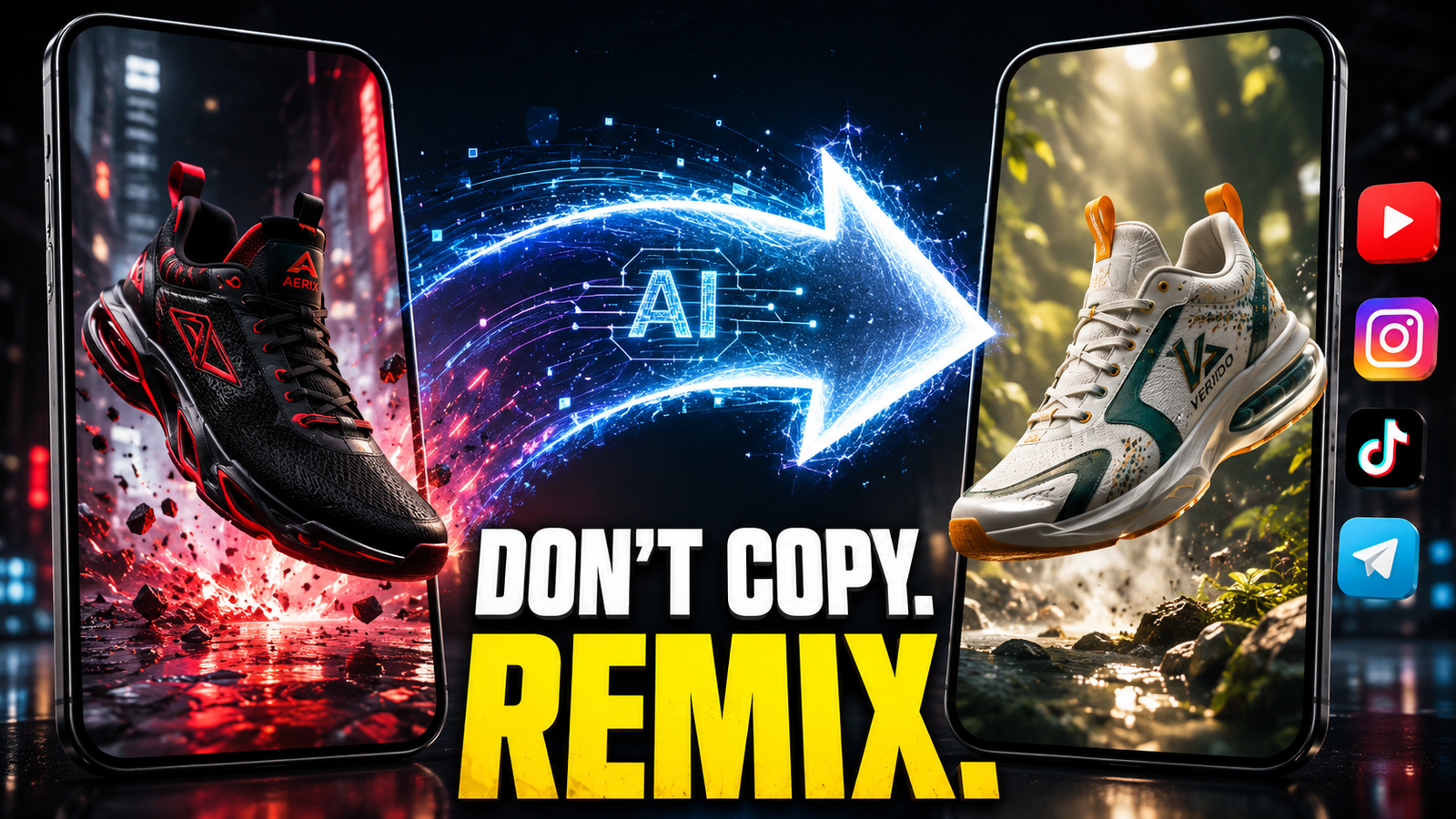
For example, imagine a viral sneaker video opens with a dramatic close-up, immediately demonstrates a distinctive feature, cuts rapidly between lifestyle scenes, and ends with a strong visual payoff.
A shoe company could use that structure for its own product.
The product would change.
The scenes would change.
The copy would change.
The brand would change.
The footage would change.
The story would change.
What remains is the content logic.
Copying vs. Adapting a Viral Format
This distinction is critical.
Copying
You reproduce:
- the same footage
- the same script
- the same person
- the same music
- the same visual sequence
- the same product presentation
- the same branding
- or other protected creative elements without authorization.
Adapting
You identify:
- the hook
- the narrative structure
- the content format
- the pacing
- the audience psychology
- the demonstration concept
…and rebuild the content using your own creative assets.
A simple rule:
Copy the lesson, not the asset.
That doesn’t mean every adaptation is automatically legally safe. Rights can exist in videos, music, photography, logos, likenesses, scripts, and other creative elements. Your responsibilities also depend on the platform and jurisdiction.
Fetra’s own current terms make the distinction especially important: users remain responsible for having the necessary rights and permissions for uploaded or published materials and for complying with intellectual-property and platform rules. Fetra also states that AI output can be inaccurate, unsuitable, or non-compliant and requires user review before publication.
So AI does not turn an unauthorized source video into automatically safe content.
The Viral-to-Brand Framework
A reliable workflow can be reduced to seven stages:
1. Discover
Find a video or format that demonstrates strong audience response.
2. Deconstruct
Identify the hook, structure, pacing, presentation, and psychological trigger.
3. Translate
Ask how the underlying format applies to your product or audience.
4. Rebuild
Create a new script, visual concept, and product presentation.
5. Brand
Apply your brand voice, visual identity, product, spokesperson, and CTA.
6. Distribute
Adapt the concept for the platforms where your audience spends time.
7. Learn
Measure the result and use the information to improve the next iteration.
This turns viral content from something you consume into something you learn from.
Step 1: Find a Proven Format
The first step is finding content worth studying.
Look for videos that demonstrate:
- strong engagement
- unusual retention
- clear product demonstrations
- compelling hooks
- simple storytelling
- strong emotional reactions
- repeatable formats
- UGC patterns
- visual demonstrations
- before-and-after structures
- problem/solution structures
You don’t necessarily need to reproduce the most viral video you can find.
A better candidate is a format that naturally fits your product.
For example:
SaaS company
Look for:
“I didn’t realize this tool could do this…”
Fitness brand
Look for:
“I tried this for 30 days…”
Ecommerce brand
Look for:
“Here’s what happens when…”
Agency
Look for:
“We tested X so you don’t have to.”
The format should create a bridge between the viewer’s existing interest and your product.
Step 2: Understand Why the Video Worked
This is where most content remixing strategies become weak.
Watching a viral video isn’t enough.
You need to analyze it.
Ask:
Hook
What happens during the first few seconds?
Curiosity
What question does the viewer want answered?
Problem
What pain point is being introduced?
Payoff
What makes the viewer stay?
Demonstration
Does the video show rather than tell?
Pacing
How quickly does the content move?
Emotional trigger
Does it create curiosity, surprise, humor, desire, fear, excitement, or identification?
CTA
What does the viewer do at the end?
This analysis gives you a reusable content blueprint.
Step 3: Add Your Brand DNA
Once you understand the format, the next challenge is making the output actually feel like your company.
This is where generic AI content often fails.
If an AI system doesn’t understand:
- your audience
- your product
- your positioning
- your tone
- your visual identity
- your messaging
- your differentiators
…it has very little reason to produce content that feels uniquely yours.
A brand context layer solves part of that problem.
In the Fetra workflow described in the original test, the platform starts by analyzing a business website and creating a profile called Business DNA, incorporating elements such as brand identity, audience, visual style, messaging, and tone.
The current Fetra site similarly describes a brand-memory system designed to maintain tone, visual style, and content boundaries across content creation.
The broader principle is more important than the feature name:
AI content becomes more useful when the system has persistent context about the business.
Instead of repeatedly explaining your company in every prompt, you create a reusable foundation.
Step 4: Rebuild the Concept
Now take the viral structure and rewrite it for your business.
A useful transformation looks like this:
Original format
Hook → Problem → Demonstration → Result → CTA
Your brand
Brand-specific hook → Customer problem → Your product demonstration → Your outcome → Your CTA
For example:
Original concept
“Three things I wish I knew before buying running shoes.”
Adapted concept
“Three things I wish I knew before choosing running shoes for marathon training.”
The structure is similar.
The actual educational content, examples, product, footage, positioning, and messaging can be completely different.
That is what makes the format useful.
Step 5: Create Consistent Brand Characters
Some products are difficult to demonstrate without a person.
Hiring actors for every campaign is expensive.
Appearing on camera yourself can also become a production bottleneck.
This is where AI-generated presenters and UGC-style characters can become useful.
The script’s Fetra test describes an AI Influencers workflow where a reusable digital personality can be configured with characteristics such as appearance, style, and personality, and then used for talking-avatar or UGC-style videos.
The strategic advantage isn’t simply “AI avatars look cool.”
It is consistency.
A reusable presenter can potentially give a campaign:
- recognizable identity
- consistent presentation
- repeatable production
- faceless content options
- scalable UGC-style assets
- a recurring visual character
However, human review remains important. AI-generated presenters can produce unnatural expressions, incorrect gestures, pronunciation problems, or messaging that doesn’t fit the brand.
Step 6: Turn One Video Into a Campaign
A common mistake is treating the completed video as the final product.
It’s actually the beginning.
One campaign concept can produce:
Video
One primary short-form video.
Variations
- different hooks
- different openings
- different CTAs
- different product demonstrations
Social posts
- educational post
- promotional post
- product post
- discussion post
- carousel
- quote post
Supporting content
- behind-the-scenes post
- customer question
- FAQ
- testimonial
- product comparison
Distribution
The same campaign can then be adapted to the channels where the brand has an audience.
This is much more efficient than independently inventing content for every platform.
The Fetra workflow described in the script follows this principle through its Social Growth Manager, which generates supporting social content from a campaign and adapts formats for different platforms.
Step 7: Publish and Organize the Campaign
Content creation is only half the system.
Without distribution and organization, even excellent content can disappear.
A scalable workflow needs:
Creation → Approval → Scheduling → Publishing → Measurement → Learning
The original workflow uses Fetra’s Library and Calendar to keep generated assets and planned content organized.
The current Fetra product positioning similarly emphasizes planning, publishing, calendars, analytics, and multi-platform workflows.
This is an important distinction between an AI content generator and an AI content workflow.
A generator answers:
“Can you make this?”
A workflow answers:
“Can we repeatedly produce, approve, distribute, and improve this?”
For a business, the second question is usually more valuable.
Using Fetra AI as an Example Workflow
Fetra AI is a useful example because its current product positioning extends beyond basic text generation. It describes a workflow that combines viral-content discovery, brand context, content generation, remixing, AI UGC, publishing, calendars, and analytics.
The workflow tested in the source video can be understood as six connected components.
1. Business DNA: Establish Brand Context
The first step is teaching the platform about the business.
According to the original test, the process begins with a website and uses that information to build a Business DNA profile.
Strategically, this solves a major problem with AI content:
context loss.
Without brand context:
“Write a social media post about our product.”
With brand context:
“Create a social post using our established audience, positioning, voice, visual direction, and product information.”
The second instruction is much closer to how a real marketing team operates.
2. Blitz: Generate Multiple Creative Directions
The script describes Blitz as the ideation layer.
Instead of starting with a blank prompt, it uses the brand context to generate multiple content concepts, hooks, storytelling angles, educational formats, and UGC-style concepts.
This is strategically useful because creative teams rarely need one idea.
They need options.
A better process is:
Generate → Compare → Select → Refine
rather than:
Generate → Accept
The distinction matters because AI-generated content should be treated as a creative starting point, not automatically as the final answer.
3. Viral Remix: Turn Proven Structures Into New Concepts
This is the feature most closely connected to the primary search intent.
The source workflow describes uploading a trending video and a product or brand image. Fetra then analyzes characteristics such as the hook, pacing, storytelling, and presentation and rebuilds the format around the user’s business.
Conceptually:
Trending video
↓
Analyze format
↓
Extract creative pattern
↓
Apply business context
↓
Generate new branded content
That is the core of viral-to-brand transformation.
The key word is new.
A successful system should help you produce something that communicates your own product story rather than simply duplicating another creator’s work.
4. AI Influencers: Build a Repeatable Presenter
The AI Influencer component addresses a different bottleneck.
Some businesses need people in their videos but don’t want to:
- hire talent for every campaign
- film themselves constantly
- coordinate shoots
- maintain a studio
- repeat the same production process
A reusable AI presenter can provide a consistent visual identity.
This is particularly interesting for:
- faceless YouTube channels
- ecommerce brands
- SaaS companies
- educational businesses
- agencies
- social media teams
The source test used the resulting AI personality to create talking-avatar content from a supplied script.
But the strategic lesson is broader:
A consistent character can become part of a brand’s content system.
5. Social Growth Manager: Expand the Campaign
Once the video exists, supporting content can be created around it.
Instead of publishing one video and moving on, build a content ecosystem.
For example:
| Campaign Asset | Purpose |
|---|---|
| Hero video | Primary attention |
| Short variation | Creative testing |
| Educational post | Build authority |
| Product post | Drive consideration |
| FAQ | Remove objections |
| UGC post | Build trust |
| CTA post | Encourage action |
| Story/post reminder | Extend campaign life |
The source workflow describes Fetra generating multiple social posts from the campaign and adapting content structures for different platforms.
This is where content repurposing becomes content multiplication.
6. Library + Calendar: Turn Content Into an Operating System
A large content library can become chaotic very quickly.
You need to know:
- What has been created?
- What has been approved?
- What is scheduled?
- Which campaign does it belong to?
- Where has it been published?
- What needs to be repurposed?
- What should be tested next?
The source workflow describes the Library as a central place for generated assets and the Calendar as the planning layer for upcoming campaigns.
The broader lesson is important:
Content volume without content operations creates another problem.
Automation should reduce operational complexity—not simply create more files.
Watch Full tutorial: Turn Viral Videos Into Branded Content in Minutes With Fetra AI
From One Viral Video to an Entire Campaign
Here’s what the workflow could look like for an ecommerce brand.
Starting point
A viral short demonstrates a product using:
Hook → Close-up → Demonstration → Lifestyle shot → Result
Step 1
Analyze the structure.
Step 2
Identify the customer problem.
Step 3
Replace the original product with your product.
Step 4
Rewrite the script around your value proposition.
Step 5
Generate your own visuals.
Step 6
Create three different hooks.
Step 7
Create two different CTAs.
Step 8
Create supporting social posts.
Step 9
Schedule the campaign.
Step 10
Measure which variation performs best.
You now have something more valuable than a single video.
You have a creative testing system.
The Content Repurposing Flywheel
A strong AI content workflow can be represented as:
        TREND DISCOVERY
              ↓
        VIRAL ANALYSIS
              ↓
        BRAND CONTEXT
              ↓
        ORIGINAL CONCEPT
              ↓
        VIDEO CREATION
              ↓
       PLATFORM ADAPTATION
              ↓
          PUBLISHING
              ↓
          PERFORMANCE
              ↓
        CREATIVE LEARNING
              ↓
        NEXT CAMPAIGN
              ↺
The last step is what turns content production into a flywheel.
Every campaign should teach you something about:
- hooks
- audience preferences
- products
- platforms
- formats
- messaging
- creative angles
Viral Remix vs. Traditional Content Creation
| Approach | Traditional Workflow | Viral-Remix Workflow |
|---|---|---|
| Idea discovery | Brainstorm | Research proven patterns |
| Creative direction | Start from blank page | Start from an observed format |
| Brand context | Repeated manually | Reusable context |
| Production | Often sequential | AI-assisted |
| Variations | Time-consuming | Easier to generate |
| Repurposing | Separate task | Built into campaign |
| Publishing | Multiple tools | Centralized workflow |
| Learning | Often informal | Can become systematic |
The viral-remix model isn’t automatically better for every campaign.
Original creative development remains valuable.
The strongest strategy is usually a combination:
Original ideas + proven formats + continuous testing.
Advantages of an AI Viral-Remix Workflow
Faster creative research
You spend less time starting from zero.
More creative variations
Instead of committing to the first idea, you can explore multiple hooks and formats.
Better brand consistency
Persistent brand context can help reduce generic AI output.
More efficient production
AI can automate portions of ideation, scripting, visual production, and publishing.
Easier content repurposing
One campaign can produce multiple assets.
Better operational organization
Libraries and calendars make high-volume production easier to manage.
Limitations You Should Understand
AI does not solve every marketing problem.
1. Viral does not mean relevant
A format can perform brilliantly for another audience and fail for yours.
2. AI cannot guarantee virality
No workflow can reliably guarantee views, engagement, revenue, or rankings.
Fetra itself states in its terms that it does not guarantee account growth, reach, engagement, revenue, ranking, or publishing success.
3. Generated content still needs review
AI can create:
- incorrect claims
- awkward language
- inaccurate product information
- unsuitable visuals
- repetitive concepts
- platform-inappropriate content
Fetra explicitly places responsibility for reviewing and approving AI-generated content on the user.
4. Rights still matter
You need appropriate rights to use source materials, music, images, likenesses, logos, and other third-party assets.
5. More content isn’t necessarily better
Publishing 100 mediocre posts does not automatically beat publishing 10 excellent ones.
6. Platform rules change
Social APIs, publishing permissions, content policies, and algorithmic behavior can change.
Common Mistakes
Mistake 1: Copying instead of analyzing
The goal isn’t to recreate the same video.
Ask:
“What made this work?”
not:
“How can I duplicate this?”
Mistake 2: Using a viral format that doesn’t fit the product
A format can be popular and still be completely wrong for your audience.
Choose relevance over raw virality.
Mistake 3: Letting AI invent your brand
Your brand should provide:
- positioning
- tone
- product facts
- audience
- differentiators
- claims
- boundaries
AI should help execute the strategy.
Mistake 4: Publishing without review
Always inspect:
- factual claims
- product details
- spelling
- visual accuracy
- CTA
- copyright-sensitive assets
- disclosures
- platform requirements
Mistake 5: Creating for every platform identically
A TikTok, LinkedIn post, YouTube Short, Pinterest post, and Instagram Reel may share a campaign idea, but they don’t necessarily need identical execution.
Mistake 6: Measuring views only
Track metrics that connect to your objective.
Depending on the campaign, that might include:
- retention
- completion rate
- saves
- shares
- clicks
- leads
- conversions
- revenue
Best Practices for Viral-to-Branded Content
Start with the audience
Before asking what is viral, ask what your customer needs.
Deconstruct before creating
Write down the structure of the source video.
Change the creative expression
Use your own footage, products, visuals, script, examples, and messaging.
Keep brand context centralized
Maintain a reliable source of truth for brand voice and positioning.
Generate variations
Test multiple hooks rather than assuming one will work.
Create campaigns, not isolated posts
Think beyond one video.
Repurpose strategically
Adapt ideas instead of blindly duplicating them.
Keep humans in the approval loop
AI should accelerate judgment, not eliminate it.
Measure and learn
The best content system becomes smarter over time.
A Practical Decision Framework
Before remixing any viral video, score it from 1–5.
| Question | Score |
|---|---|
| Is it relevant to our audience? | /5 |
| Does the structure fit our product? | /5 |
| Is the hook adaptable? | /5 |
| Can we create original visuals? | /5 |
| Can we add a meaningful brand angle? | /5 |
| Does it support our marketing goal? | /5 |
| Can we legally use the required assets? | /5 |
Score interpretation
30–35: Strong candidate
24–29: Worth testing
18–23: Needs significant adaptation
Below 18: Find another format
This framework prevents the team from chasing trends simply because they are trending.
Who Should Use This Workflow?
Content creators
Useful when you need to produce consistently without starting every video from scratch.
Small businesses
Useful when a small team needs to compete with brands that have dedicated content departments.
Marketing agencies
Useful when managing multiple clients and needing repeatable campaign workflows.
Growing brands
Useful when content production becomes too complex for spreadsheets and disconnected tools.
The source video reaches a similar conclusion: the strongest value is not necessarily an individual feature, but how the components work together as a repeatable workflow.
Is Fetra AI Worth Considering?
If your primary problem is simply writing captions, a dedicated writing tool may be enough.
If your main problem is video editing, a dedicated video editor may be more appropriate.
But if your problem looks like this:
Trend research → ideation → branded video → AI presenter → social posts → scheduling → content organization
then a more integrated platform becomes more interesting.
Fetra currently positions itself around precisely this broader workflow, including viral-content discovery, brand memory, content creation, publishing, calendars, analytics, and AI-assisted marketing functions.
Its current pricing page also lists a free tier and paid plans with progressively larger content and social-account allowances, although pricing and included features can change, so readers should verify the current offer before purchasing.
Best fit
Fetra is particularly worth testing if you:
- publish frequently
- manage multiple social channels
- want AI-assisted video production
- need repeatable content workflows
- want to experiment with viral formats
- operate a faceless or AI-assisted brand
- manage content for clients
Less compelling if
You:
- publish very occasionally
- already have a mature production stack
- need highly specialized professional video editing
- require extensive human production
- don’t actually have a recurring content problem
Frequently Asked Questions
What does it mean to turn a viral video into branded content?
It means analyzing the underlying structure of a successful video and rebuilding that structure around your own brand, product, audience, messaging, and creative assets rather than simply copying the original.
Can I copy a viral video for my business?
You should not assume that a viral video is free to copy. Copyright, trademarks, music rights, likeness rights, platform rules, and other legal considerations can apply. The safer strategic approach is to learn from the format and create your own execution using assets you have the right to use.
How do you make a viral video original?
Change the creative expression: use your own script, product, visuals, examples, story, presenter, brand voice, and CTA. The more meaningful the transformation, the less the content resembles a direct reproduction.
Can AI turn a viral video into branded content?
AI can assist with analyzing and adapting content structures, generating scripts, creating visuals, producing variations, and applying brand context. It does not remove the need for human review, rights checks, or creative judgment.
What is the best way to find viral video ideas?
Look for content with strong hooks, clear storytelling, demonstrations, unusual engagement, or repeatable formats. More importantly, choose formats that make sense for your target audience and product.
Can one viral video become multiple social posts?
Yes. A single campaign can become videos, short clips, educational posts, product posts, FAQs, carousels, stories, and other platform-specific assets.
What is Business DNA in Fetra AI?
In the workflow described in the source video, Business DNA is the brand context created after Fetra analyzes a business website and its identity, audience, visual style, messaging, and tone.
What is Viral Remix in Fetra AI?
Viral Remix is the workflow described in the source video for uploading a trending video and product or brand material so Fetra can analyze aspects such as hook, pacing, storytelling, and presentation and generate a new branded version.
Can Fetra AI publish to multiple social networks?
The source workflow describes connected social publishing across platforms including YouTube, Instagram, Facebook, LinkedIn, TikTok, X, Pinterest, Threads, and Bluesky. Current availability and permissions can change, so users should verify supported integrations in the product before relying on a particular platform.
Does Fetra guarantee viral results?
No. Fetra’s terms explicitly state that it does not guarantee growth, reach, engagement, revenue, ranking, or publishing success.
Should every brand use AI influencers?
No. AI influencers are most useful when consistent presenter-based content is valuable. Some brands will perform better with real customers, employees, founders, professional actors, or product-led creative.
Is AI-generated content ready to publish automatically?
Not necessarily. AI-generated content should be reviewed for accuracy, brand fit, rights, compliance, and platform suitability. Fetra’s own terms place responsibility for reviewing and approving content on the user.
Final Thoughts
The biggest opportunity in viral content isn’t copying what already exists.
It’s learning faster.
A viral video can give you a window into:
- what captures attention
- how a story is structured
- which problems resonate
- how products are demonstrated
- what presentation styles attract viewers
- how quickly information should move
The mistake is stopping at imitation.
The better approach is:
Observe → Analyze → Adapt → Create → Distribute → Measure → Learn.
AI makes that loop increasingly practical.
Instead of spending hours searching for one idea, you can analyze patterns and generate multiple possibilities.
Instead of rebuilding your brand context in every prompt, you can create a reusable foundation.
Instead of producing one video, you can build an entire campaign.
Instead of jumping between disconnected tools, you can move toward a unified content workflow.
That’s the real promise behind tools such as Fetra AI.
Not that AI magically makes every video viral.
But that it can reduce the repetitive work between finding an idea and consistently turning that idea into branded content.
And for creators, small businesses, agencies, and growing brands, that workflow can be much more valuable than another isolated AI writing tool.
Ready to Test the Workflow?
If you want to experiment with turning proven viral formats into original branded content, Fetra AI is worth testing as one possible workflow.
Try the free option first, then decide whether the broader creation, remixing, AI-influencer, publishing, and campaign-management features justify a paid plan for your workflow.
Affiliate disclosure: We may earn a commission if you purchase through our link. This does not increase your price and does not change our editorial assessment.
Before purchasing, check Fetra’s current pricing, feature limits, integrations, and terms because software plans and capabilities can change.
Read more: From 1 Image to Viral Cinematic AI Ads