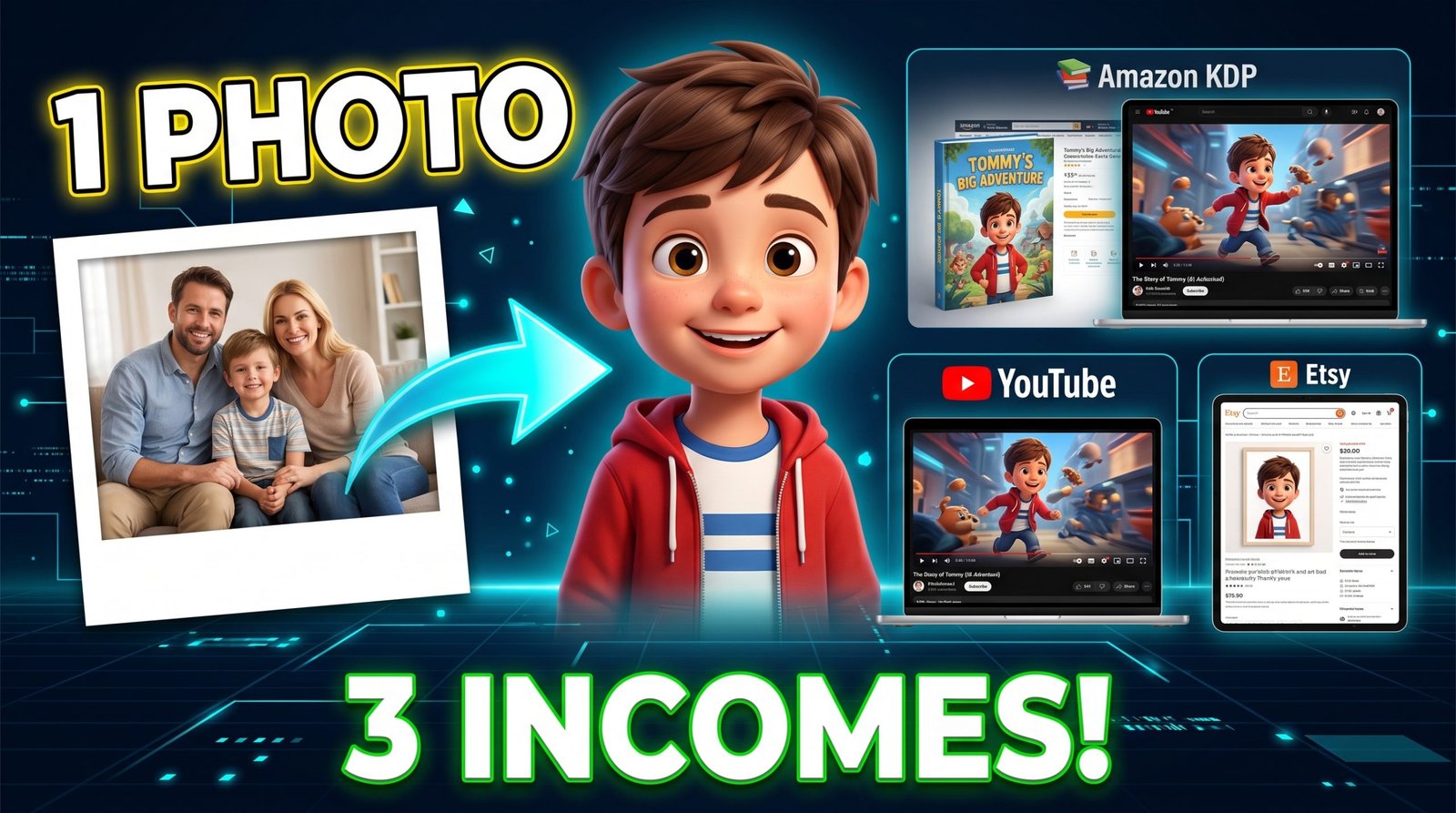
Learn how to transform a single photograph into a consistent children’s book character, illustrated picture book, animated YouTube video, Amazon KDP book, Etsy product, and scalable publishing business using AI. A complete step-by-step guide.
Social Sharing Description
What if one ordinary photo could become a children’s book, an animated YouTube video, an Amazon KDP bestseller, an Etsy digital product—and even the foundation of your own publishing brand? This guide shows the complete AI workflow from idea to intellectual property.
Executive Summary
Artificial intelligence has dramatically lowered the barriers to creating books, illustrations, and videos. Today, almost anyone can generate a children’s story or produce eye-catching artwork in minutes. But while creating content has become easier than ever, building something that readers remember—and that can grow into a sustainable business—remains a very different challenge.
The biggest obstacle is no longer generating a single image or writing a single story. It’s creating a character that stays recognizable across every page, every illustration, every animation, and every product. Successful children’s brands are built on consistency, not randomness.
This guide explores a complete AI-powered publishing workflow that begins with one ordinary photograph and transforms it into a reusable creative asset. Using ReadKidz as the primary example, you’ll learn how to:
- Turn a real photo into a consistent children’s character.
- Generate original stories around that character.
- Create professionally illustrated picture books.
- Publish on Amazon KDP.
- Sell digital products on Etsy.
- Transform books into animated YouTube videos.
- Build intellectual property that can expand into a long-term publishing business.
Rather than focusing on a single AI tool, this article introduces a repeatable framework for creating scalable children’s media. Whether you’re a parent making personalized stories, a teacher creating classroom materials, or an entrepreneur building a publishing brand, the principles remain the same: create memorable characters, tell meaningful stories, and multiply each creative asset across multiple platforms.
Quick Answer
Can AI Really Create a Children’s Publishing Business from One Photograph?
Yes—but the real opportunity isn’t the photograph itself.
The photograph is simply the starting point.
The real value comes from transforming that image into a consistent character that can appear across books, animations, educational materials, digital products, and future story collections.
A modern AI publishing workflow typically follows this sequence:
| Stage | Output |
| Photograph | Character Reference |
| Character | Original Story |
| Story | Illustrated Picture Book |
| Picture Book | Amazon KDP Book |
| Book | Etsy Digital Product |
| Book | Animated Video |
| Animated Video | YouTube Content |
| Multiple Stories | Children’s Brand & Intellectual Property |
Instead of creating a single product, you’re creating an ecosystem of reusable creative assets.
Key Takeaways
Before diving into the complete workflow, here are the most important ideas you’ll learn throughout this guide.
✔ AI is best used as a creative accelerator—not a replacement for human creativity.
Great children’s books still require thoughtful storytelling, emotional connection, and careful editing.
✔ Memorable characters create long-term value.
Children rarely remember every individual story.
They remember characters.
Strong characters become books, videos, merchandise, educational materials, and recognizable brands.
✔ Character consistency is one of the biggest challenges in AI publishing.
Maintaining the same appearance, personality, clothing, expressions, and proportions across dozens of illustrations has historically required professional artists.
Modern AI workflows are beginning to solve this problem.
✔ One story can become many products.
Instead of creating one book, creators can repurpose the same intellectual property into:
- Print books
- eBooks
- Animated videos
- Printable activities
- Classroom resources
- Digital downloads
- YouTube content
- Social media clips
✔ The most successful creators think like publishers—not prompt engineers.
Learning better prompts is helpful.
Building reusable intellectual property is transformational.
Table of Contents
- Introduction
- Why AI Is Changing Children’s Publishing
- Why Characters Matter More Than Stories
- Understanding AI Intellectual Property
- The AI Publishing Flywheel Framework
- Creating Consistent Characters from Photos
- Building Stories Around Characters
- Illustration Workflows
- Storyboarding Like a Professional Studio
- Publishing to Amazon KDP
- Selling on Etsy
- Turning Books into Animated Videos
- Growing a YouTube Kids Channel
- Scaling into a Children’s Publishing Business
- Best Practices
- Common Mistakes
- Frequently Asked Questions
- Final Thoughts
Table of Contents
Introduction
Children’s publishing has traditionally been one of the most demanding creative industries.
A single professionally illustrated picture book often requires months of work from multiple specialists, including:
- Authors
- Editors
- Character designers
- Illustrators
- Layout artists
- Cover designers
- Publishers
- Marketing teams
For independent creators, these costs can quickly become overwhelming. Hiring illustrators alone may cost hundreds or even thousands of dollars, while maintaining consistent artwork across an entire series requires significant planning and artistic expertise.
Artificial intelligence is changing that landscape.
Today’s AI tools can assist with story generation, illustration, layout, voice narration, animation, and even publishing preparation. Tasks that once required multiple software packages and specialized skills can now be completed through integrated workflows.
However, there’s an important distinction between generating content and creating lasting value.
Anyone can ask an AI to write a children’s story.
Anyone can generate a colorful illustration.
But creating a character that readers recognize instantly across multiple books—that’s a far more ambitious goal.
Consider some of the world’s most successful children’s franchises.
Readers may not remember every individual adventure, but they immediately recognize the central characters. Those characters become the foundation for sequels, television shows, educational materials, toys, games, and licensing opportunities.
In other words, successful children’s publishing is rarely built around a single book.
It’s built around intellectual property.
This guide approaches AI from that perspective.
Instead of asking:
“How do I create one AI children’s book?”
We’ll explore a more valuable question:
“How do I create a children’s publishing system capable of producing books, videos, digital products, and future story worlds?”
That shift in mindset changes everything.
Why This Matters
Artificial intelligence has made content creation dramatically more accessible.
Yet accessibility also creates a new challenge:
When everyone can generate content, quality alone is no longer enough.
Creators need assets that are:
- Recognizable
- Consistent
- Expandable
- Commercially reusable
The children’s publishing industry has always rewarded these qualities.
Characters like friendly bears, adventurous siblings, imaginative animals, and magical creatures become familiar companions for young readers. Parents look for them. Children request them by name. Publishers build entire product lines around them.
This isn’t simply because the stories are entertaining.
It’s because consistent characters create trust.
When a child connects emotionally with a character, every future story becomes easier to enjoy.
AI can now help independent creators build those foundations more efficiently than ever before—but only when it’s used strategically.
Rather than treating AI as a shortcut, successful creators use it as a collaborative tool that accelerates research, visualization, drafting, and production while leaving creative direction in human hands.
The result is a workflow that combines the speed of automation with the originality of thoughtful storytelling.
For entrepreneurs, this represents more than a creative opportunity.
It represents a business opportunity.
A single well-designed character can become the foundation for:
- A picture book series
- Educational workbooks
- Printable classroom resources
- Personalized family books
- YouTube animations
- Audiobooks
- Interactive storytelling experiences
- Merchandise
- Licensing opportunities
- Subscription content
Instead of creating isolated projects, creators can build connected ecosystems where each new story strengthens the value of the entire brand.
This approach also reduces one of the biggest risks in content creation: constantly starting from scratch.
Every new book doesn’t require inventing a new world, a new cast of characters, or a new visual identity. Instead, creators can expand an existing universe that readers already recognize and enjoy.
That is the real promise of AI-assisted publishing.
It isn’t about replacing creativity.
It’s about giving creators better tools to develop ideas that can grow over time.
And as you’ll see throughout this guide, the journey doesn’t begin with complex prompts or advanced technical skills.
Sometimes, it begins with something as simple as a single photograph.
The New Era of AI Children’s Publishing
Only a few years ago, creating a professional children’s picture book was a significant undertaking. Even a short 24-page book typically required months of collaboration between writers, illustrators, editors, designers, and publishers. For many aspiring authors, the cost of hiring experienced illustrators alone placed publishing out of reach.
Artificial intelligence is changing that equation.
Today’s AI tools can help generate stories, illustrate scenes, design book layouts, narrate audiobooks, and even animate entire picture books. Tasks that once required multiple software packages and specialized creative teams can now be completed within a single workflow.
This technological shift is democratizing children’s publishing. Independent creators, educators, parents, and small businesses now have access to capabilities that were once reserved for established publishing houses.
However, increased accessibility also creates a new challenge.
When almost anyone can generate attractive illustrations or write a basic story using AI, simply producing content is no longer enough to stand out. The competitive advantage shifts away from “who can make a book” and toward “who can create memorable intellectual property.”
This distinction is crucial.
Many AI-generated books are technically impressive, yet they are quickly forgotten because they lack recognizable characters, emotional continuity, or a larger creative vision. They exist as isolated projects rather than parts of a growing universe.
The most successful creators are approaching AI differently.
Instead of asking:
“How can AI write my next children’s book?”
They ask:
“How can AI help me build a children’s publishing brand that grows stronger with every new story?”
That single change in perspective transforms AI from a content generator into a business accelerator.
The Evolution of AI Publishing
The development of AI publishing can be viewed in three distinct stages.
| Generation | Primary Focus | Typical Outcome |
| First Generation | Generate isolated images or stories | Standalone creative assets |
| Second Generation | Produce complete books with AI | Finished but disconnected publications |
| Third Generation | Build reusable characters and intellectual property | Expandable publishing ecosystems |
Most online tutorials still focus on the first or second generation. They demonstrate how to create an individual story, generate artwork, or publish a single book.
This guide focuses on the third generation.
The goal is not merely to publish once. It is to build assets that become more valuable over time.
Why Characters Matter More Than Stories
Ask an adult to describe every episode of Bluey.
Most people can’t.
Ask them who Bluey is.
Almost everyone knows.
The same principle applies to many of the world’s most successful children’s franchises.
Children remember:
- Bluey
- Peppa Pig
- Paddington Bear
- Winnie-the-Pooh
- Curious George
- The Very Hungry Caterpillar
They don’t remember every plot in chronological order.
They remember the characters.
Characters become emotional anchors.
They create familiarity.
They establish trust.
They encourage children to return for another adventure.
Every new story becomes easier to enjoy because the audience already understands who the characters are.
This is why professional animation studios spend extraordinary amounts of time developing character reference sheets before writing hundreds of pages of storyboards.
The character comes first.
The stories come afterward.
The Character-First Publishing Model
Traditional beginners often follow this workflow:
Story Idea
↓
Illustrations
↓
Book
↓
Done
Professional publishers think differently.
Character
↓
Character Bible
↓
Story World
↓
Book Series
↓
Animation
↓
Merchandise
↓
Licensing
↓
Brand
This difference explains why some children’s books remain one-time purchases while others evolve into global franchises.
The character becomes the foundation for everything else.
Why AI Has Traditionally Struggled
Historically, one of AI’s greatest weaknesses has been consistency.
An AI image model might create an adorable character on page one.
By page six, the hairstyle changes.
The clothing changes.
Facial proportions change.
The personality seems different.
The reader subconsciously notices these inconsistencies, even if they cannot explain why.
For children’s publishing, consistency is essential.
Young readers build emotional relationships with familiar faces. When those faces constantly change, immersion breaks.
Modern workflows increasingly solve this problem through character reference systems.
Instead of asking AI to invent a new character for every illustration, creators first establish a visual identity—a reference sheet that defines the character’s appearance, expressions, clothing, and proportions. Every future illustration is generated from that shared foundation.
This mirrors the workflow used by professional animation studios.
The technology is different, but the creative principle remains the same.
Understanding AI Intellectual Property
Many creators mistakenly believe they are in the book business.
In reality, the most successful publishers are in the intellectual property business.
A book is a product.
A character is an asset.
An intellectual property portfolio is a collection of assets that can be reused, expanded, licensed, and adapted across multiple formats.
Imagine creating a brave young explorer named Oliver.
The first book introduces Oliver to readers.
The second book takes him on a new adventure.
The third explores another magical world.
Soon, Oliver appears in activity books, educational worksheets, YouTube animations, printable games, audiobooks, and seasonal holiday specials.
Each new product strengthens the overall value of the brand.
That is the compounding effect of intellectual property.
Content vs. Intellectual Property
| Content | Intellectual Property |
| One-time output | Long-term reusable asset |
| Short lifespan | Grows over time |
| Difficult to differentiate | Recognizable identity |
| Individual product | Connected ecosystem |
| Limited monetization | Multiple revenue streams |
This shift in thinking is perhaps the most important lesson in AI publishing.
AI should not simply help you create more content.
It should help you create better assets.
The IP Pyramid
Think of your publishing business as a pyramid.
Brand
Book Series
Individual Books
Story Concepts
Main Character
Everything rests on the strength of the main character.
Without a compelling character, the entire pyramid becomes unstable.
Framework #1: The AI Publishing Flywheel
One of the biggest mistakes creators make is treating every project as completely separate.
They finish one book.
Start over.
Finish another.
Start over again.
Professional publishers don’t work this way.
They create systems.
The AI Publishing Flywheel is a repeatable framework that transforms a single creative idea into a growing ecosystem of digital assets.
Photo
↓
Character
↓
Story
↓
Illustrated Book
↓
Animation
↓
Amazon KDP
↓
Etsy
↓
YouTube
↓
Audience
↓
Feedback
↓
New Stories
↓
Expanded Brand
↓
Back to Character
Every stage strengthens the next.
Publishing a book creates content for YouTube.
YouTube builds an audience.
Audience feedback inspires new stories.
New stories increase the value of the character.
The character strengthens the brand.
The cycle repeats.
Unlike traditional linear publishing, the flywheel becomes more efficient with each iteration.
Why the Flywheel Works
Each creative project produces assets that can be reused elsewhere.
One story may generate:
- A printed picture book
- An eBook
- A narrated audiobook
- A YouTube Kids episode
- Short-form promotional clips
- Printable coloring pages
- Classroom activities
- Etsy digital downloads
- Character artwork for social media
- Future sequels
Rather than asking, “What should I create next?” the better question becomes:
“How many ways can this existing character continue delivering value?”
This approach reduces creative fatigue while maximizing the return on every story you produce.
Think Like a Studio, Not a Solo Creator
Perhaps the biggest mindset shift AI enables is this:
You no longer have to think like an individual author.
You can think like a small creative studio.
Studios don’t ask how to publish one book.
They ask how to build worlds, characters, and experiences that audiences return to again and again.
AI doesn’t replace that vision.
It accelerates its execution.
Whether your goal is to create personalized bedtime stories for your family, launch an educational publishing business, or build a YouTube Kids channel, the same principle applies:
Start with memorable characters.
Develop meaningful stories.
Create reusable intellectual property.
Then allow every new project to strengthen the entire ecosystem rather than standing alone.
Building Your AI Publishing Workflow
Step 1 — Transform a Photograph into a Consistent Character
Every memorable children’s series starts with someone readers want to follow.
Traditional publishing requires a character designer to produce multiple sketches, expression sheets, turnaround views, and style guides before a single illustration is created.
Modern AI tools can dramatically accelerate this process.
Rather than describing a character from scratch, you can begin with a real photograph and use it as the visual foundation for your protagonist.
This approach offers several advantages:
- It creates a strong visual reference from the beginning.
- It helps maintain consistency throughout the project.
- It makes personalized books possible.
- It significantly reduces the time spent refining character designs.
For example, a parent might transform their child into the hero of an adventure story. A teacher could create classroom books featuring fictional students, while pet owners can turn their animals into recurring story characters.
These aren’t simply illustrations—they become recognizable identities that can appear throughout an entire publishing catalog.
Why Character Reference Sheets Matter
One of the biggest problems with AI-generated illustrations has always been inconsistency.
Without guidance, an AI image model treats each illustration as a completely new request.
That often leads to changing hairstyles, clothing, facial proportions, or expressions between pages.
Professional animation studios avoid this by creating character reference sheets before any production begins.
These include:
- Front view
- Side profile
- Facial expressions
- Color palette
- Clothing details
- Pose references
- Personality notes
Modern AI workflows now follow the same philosophy.
Instead of asking AI to invent a new version of your character every time, you establish the identity once and reuse it throughout the entire project.
Think of the character sheet as the visual “source of truth” for your book series.
Editorial Tip
The strongest children’s characters are usually simple rather than overly detailed.
Consider focusing on:
- A distinctive hairstyle
- One recognizable outfit
- A memorable accessory
- Clear facial expressions
- A consistent silhouette
Children recognize shapes long before they notice intricate artistic details.
Step 2 — Build Stories Around Characters
Many beginners start with a story.
Experienced publishers often begin with a character.
There’s a simple reason for this.
Readers develop emotional connections with characters, not plot outlines.
Ask someone to summarize every story featuring Paddington Bear or Bluey and they may struggle.
Ask them to describe the characters, and they’ll answer immediately.
The character becomes the anchor that allows hundreds of different adventures to feel connected.
The Character-Driven Story Framework
Instead of trying to invent an elaborate storyline, begin by answering five simple questions.
| Question | Example |
| Who is the main character? | A curious 9-year-old explorer |
| What do they want? | To help magical forest animals |
| What stands in their way? | Mysteries, obstacles, or fears |
| Who helps them? | Friends, siblings, mentors |
| What lesson do they learn? | Kindness, courage, teamwork |
These five questions provide enough structure for AI to generate an engaging first draft.
AI as a Creative Partner
One of the biggest misconceptions surrounding AI writing is that the first draft should be publishable.
In reality, AI performs best when treated as a collaborator rather than a replacement.
A practical workflow looks like this:
- Generate a first draft.
- Read it critically.
- Remove repetitive sections.
- Strengthen emotional moments.
- Improve dialogue.
- Add humor or suspense where appropriate.
- Rewrite the ending to leave a lasting impression.
AI solves the “blank page” problem.
The creator shapes the final story.
Expert Insight
The most memorable children’s stories usually revolve around a single emotional lesson.
Examples include:
- Courage
- Friendship
- Curiosity
- Honesty
- Perseverance
- Sharing
- Respect for nature
- Empathy
Keeping the moral simple makes the story more memorable and easier for young readers to understand.
Step 3 — Choosing an Illustration Style
Illustrations do far more than decorate a story.
They establish tone, atmosphere, and emotional connection.
The same story can feel completely different depending on the chosen art style.
For example:
| Style | Best For |
| Watercolor | Gentle bedtime stories |
| Soft Pastel | Preschool readers |
| Storybook Classic | Traditional publishing |
| Cartoon | Educational books |
| 3D Stylized | Modern YouTube audiences |
| Paper Cut | Craft-inspired projects |
| Anime Inspired | Older children |
| Digital Painting | Fantasy adventures |
Rather than choosing your personal favorite, choose the style that best serves your audience.
A bedtime story benefits from soft colors and calming illustrations.
An adventure story may benefit from stronger lighting, vibrant colors, and cinematic compositions.
Consistency Over Variety
Changing artistic styles halfway through a book can confuse readers.
Once you’ve selected an illustration style, maintain it throughout the project.
Consistency creates familiarity.
Familiarity creates trust.
Trust encourages children to keep reading.
Step 4 — Storyboarding Like a Professional Studio
One of the least appreciated stages of publishing is storyboarding.
Many creators are eager to generate final illustrations immediately.
Professional studios do the opposite.
They plan first.
Storyboards provide a blueprint for the entire book before expensive production begins.
A storyboard allows you to evaluate:
- Story pacing
- Scene transitions
- Emotional flow
- Character development
- Page turns
- Visual balance
Making changes during the storyboard stage takes minutes.
Making those same changes after generating twenty illustrations may take hours.
Questions to Ask During Storyboarding
Before approving each page, ask:
- Does this page move the story forward?
- Is there enough visual variety?
- Will children want to turn the next page?
- Is every illustration necessary?
- Does the emotional intensity rise naturally?
Storyboards prevent beautiful illustrations from supporting weak storytelling.
Storyboard Planning Checklist
✔ Strong opening
✔ Clear conflict
✔ Rising action
✔ Emotional climax
✔ Satisfying ending
✔ Positive lesson
Step 5 — Creating Consistent Illustrations
Illustration consistency is one of the defining characteristics of professional children’s books.
Readers should immediately recognize the protagonist on every page.
Achieving this consistency requires more than generating attractive artwork.
It requires maintaining:
- Hair
- Clothing
- Colors
- Body proportions
- Expressions
- Age
- Personality
When every page feels connected, readers stop noticing the illustrations themselves.
Instead, they become immersed in the story.
That immersion is the hallmark of successful children’s publishing.
Comparing Traditional vs AI-Assisted Workflows
| Traditional Publishing | AI-Assisted Workflow |
| Character designer | AI character generation |
| Illustrator | AI illustration engine |
| Storyboard artist | AI storyboard planning |
| Layout designer | Automated page layouts |
| Months of production | Hours or days |
| High production cost | Lower production cost |
| Manual revisions | Rapid iteration |
AI dramatically accelerates production, but editorial review remains essential.
Quality still depends on thoughtful decision-making.
Common Mistakes During Production
Even with modern AI tools, certain mistakes repeatedly reduce the quality of children’s books.
Mistake 1: Overcomplicated Characters
Too many accessories, colors, or intricate clothing make consistency harder to maintain.
Simple characters are easier to recognize and reproduce.
Mistake 2: Accepting the First AI Output
The first result is rarely the strongest.
Review multiple options before deciding.
Small improvements across every page create a much stronger final book.
Mistake 3: Ignoring Story Flow
Beautiful illustrations cannot compensate for confusing storytelling.
Always evaluate pacing before generating final artwork.
Mistake 4: Changing Styles Midway
Mixing illustration styles weakens the reader’s emotional connection.
Choose one visual language and stay consistent.
Mistake 5: Skipping Human Editing
AI accelerates production, but human judgment improves quality.
Grammar, dialogue, pacing, humor, and emotional impact all benefit from thoughtful editing.
Best Practices for Professional Results
To produce books that feel polished rather than automatically generated, consider these editorial practices:
- Design memorable characters before writing stories.
- Keep prompts clear and focused instead of overly detailed.
- Use consistent visual references throughout the project.
- Treat AI-generated drafts as starting points, not finished products.
- Review every page individually before publication.
- Maintain a consistent illustration style.
- Focus on emotional storytelling rather than visual complexity.
- Build recurring characters that can support future books.
- Think in terms of series rather than standalone titles.
- Repurpose each completed story into multiple formats, such as print books, eBooks, animated videos, and educational resources.
Production Workflow at a Glance
Real Photograph
│
▼
Character Reference Sheet
│
▼
Story Concept
│
▼
AI Story Draft
│
▼
Human Editing & Refinement
│
▼
Illustration Style Selection
│
▼
Storyboard Planning
│
▼
Consistent Illustrations
│
▼
Professional Picture Book
This workflow transforms AI from a simple content generator into a structured publishing system that supports long-term creative growth.
Publishing, Monetization & Building an AI Children’s Media Business
At this stage, you’ve accomplished something many aspiring authors never reach.
You have:
- A memorable main character
- A complete children’s story
- Consistent illustrations
- A professionally designed picture book
For many creators, this would be the finish line.
In reality, it’s the starting point.
One of the biggest mindset shifts in modern publishing is recognizing that a completed book is not a single product—it is a collection of reusable intellectual property.
That same story can become multiple products, reach different audiences, and generate value across several platforms without requiring you to start from scratch each time.
Let’s explore how to expand one creative project into a complete publishing ecosystem.
Step 6 — Publish Your Book on Amazon KDP
Amazon Kindle Direct Publishing (KDP) remains one of the most accessible platforms for independent authors. It allows creators to publish both eBooks and print-on-demand paperbacks without maintaining inventory or negotiating with traditional publishers.
The technical process of uploading a book is relatively straightforward. The greater challenge is making sure readers can actually discover it.
A well-designed cover and engaging story are important, but discoverability depends on factors such as:
- Clear, keyword-focused titles
- Compelling book descriptions
- Appropriate categories
- Relevant search keywords
- Professional formatting
These elements influence how your book appears in Amazon’s search results and recommendation system.
KDP Publishing Checklist
| Task | Purpose |
| Prepare interior file | Ensure proper page formatting |
| Design front and back cover | Create a professional first impression |
| Write optimized title and subtitle | Improve discoverability |
| Select accurate categories | Reach the right audience |
| Add relevant keywords | Help readers find the book |
| Preview before publishing | Catch formatting issues |
| Choose pricing and royalty | Align with your publishing goals |
Remember that publishing is an ongoing process. Monitor your listings, update metadata when appropriate, and refine future books based on reader feedback.
Formatting Tip
One common obstacle for first-time publishers is PDF formatting.
If your file doesn’t meet platform requirements, convert it into an editable document, review the layout carefully, and export it using a publishing-friendly format such as Kindle Create’s recommended output.
A small amount of preparation can prevent delays during the review process.
Step 7 — Expand into Etsy Digital Products
While Amazon focuses on books, Etsy serves a different audience—customers looking for creative, personalized, and downloadable products.
Rather than viewing Etsy as a competitor, think of it as a complementary marketplace.
The same story can become:
- Printable bedtime books
- Personalized children’s stories
- Classroom reading materials
- Activity books
- Coloring pages
- Flashcards
- Learning worksheets
- Story bundles
Digital products require no physical inventory, making them an attractive extension of an existing publishing workflow.
Why Etsy Fits AI Publishing
Parents often look for:
- Unique gifts
- Personalized keepsakes
- Educational printables
- Instant downloads
A well-designed children’s story can satisfy several of these needs simultaneously.
The key is presenting your products clearly with:
- Search-friendly titles
- Descriptive product pages
- Relevant tags
- Attractive preview images
- Helpful usage information
Good storytelling brings customers to the product.
Good listing optimization helps them find it.
Amazon KDP vs. Etsy
| Amazon KDP | Etsy |
| Physical and digital books | Primarily digital products |
| Large global book marketplace | Handmade and creative marketplace |
| Print-on-demand options | Instant digital downloads |
| Readers searching for books | Buyers searching for gifts and educational resources |
| Royalty-based sales | Direct product pricing |
Many successful creators use both platforms rather than choosing one over the other.
Step 8 — Transform Your Book into an Animated Video
One of the most exciting developments in AI publishing is the ability to reuse existing story assets rather than beginning each project from scratch.
Your completed book already contains:
- Characters
- Story structure
- Scene descriptions
- Dialogue
- Illustrations
These assets provide a strong foundation for animation.
Instead of asking AI to invent an entirely new project, you are extending an existing one.
This dramatically reduces production time while maintaining consistency.
From Book to Animation
A typical workflow looks like this:
Character Reference
│
▼
Story Script
│
▼
Storyboard
│
▼
Scene Images
│
▼
Animation
│
▼
Narration
│
▼
Background Music
│
▼
Completed Video
Because every scene is based on the same character references, the final animation feels far more cohesive than isolated AI-generated clips.
Why Animation Multiplies Value
Publishing a book reaches readers.
Publishing an animated version reaches viewers.
Many families consume stories in multiple formats.
A child might:
- Read the printed book.
- Watch the animated version.
- Listen to the narrated audiobook.
- Complete printable activities based on the same characters.
Each format reinforces the others.
Step 9 — Grow a YouTube Kids Library
By the time your animation is complete, you’ve already solved one of the hardest problems in YouTube content creation:
You have something meaningful to publish.
Instead of constantly searching for new video ideas, every completed story becomes another episode.
Over time, this creates a growing library of evergreen content.
Each upload introduces your characters to new viewers while encouraging existing audiences to return for the next adventure.
Think Beyond Individual Videos
Many creators focus exclusively on views.
Publishers focus on libraries.
A single successful character can appear in:
- Episode 1
- Episode 2
- Holiday specials
- Seasonal stories
- Educational adventures
- Bedtime stories
- Short-form clips
- Community posts
The channel grows because the world grows.
YouTube Publishing Checklist
Before publishing:
- Create an engaging thumbnail.
- Write a descriptive title.
- Optimize the video description.
- Add relevant keywords.
- Include chapter timestamps when appropriate.
- Select the correct audience settings.
- Use playlists to organize related stories.
A consistent publishing schedule often matters more than viral success.
Read more about : Automate YouTube: Build 2 FREE AI Apps (No Code) to Boost Growth Fast
Framework #2 — The Children’s Media Ecosystem
Instead of seeing each platform separately, think of them as connected parts of one creative business.
Character
│
┌───────────┼───────────┐
▼ ▼ ▼
Picture Book Animation Printable Activities
│ │ │
▼ ▼ ▼
Amazon KDP YouTube Kids Etsy
│ │ │
└───────────┼───────────┘
▼
Audience & Community
│
▼
New Stories & Series
Every platform strengthens the others.
The more places your characters appear, the more valuable your intellectual property becomes.
Scaling Beyond One Book
Many creators ask:
“How many books do I need before this becomes a real business?”
The better question is:
“How consistently can I expand one successful character?”
Consider the difference:
Creator A
- 20 unrelated books
- 20 unrelated characters
Creator B
- One memorable character
- Twenty connected adventures
The second approach builds recognition, trust, and long-term brand equity.
Best Practices
To build a sustainable AI-powered children’s publishing business:
- Create characters before stories.
- Maintain visual consistency.
- Edit every AI-generated draft.
- Focus on emotional storytelling.
- Publish across multiple formats.
- Build series instead of isolated books.
- Listen to reader feedback.
- Continuously improve future releases.
AI accelerates production.
Human creativity builds loyalty.
Frequently Asked Questions
Can AI write an entire children’s book?
Yes, AI can generate a complete first draft, but the strongest books usually benefit from human editing to improve pacing, dialogue, emotional impact, and originality.
Can AI keep characters consistent?
Modern workflows using character reference sheets greatly improve consistency, although reviewing illustrations before publication is still recommended.
Can I publish AI-assisted books on Amazon KDP?
Yes, provided your content complies with Amazon’s publishing policies and you accurately disclose AI-assisted content if required under current platform guidelines.
Can I sell AI-generated books on Etsy?
Yes. Many creators sell printable storybooks, educational resources, and personalized children’s products, provided they comply with Etsy’s marketplace policies.
Should I create one book or a series?
Whenever possible, think in terms of a series.
Recurring characters are more memorable and provide stronger long-term publishing opportunities than isolated titles.
Is YouTube worth adding?
If you’re already creating illustrated books, animation allows you to reach audiences who prefer video content.
Books and videos reinforce one another and can help build a recognizable children’s brand.
Final Thoughts
Artificial intelligence has made it easier than ever to create stories, illustrations, books, and videos.
But technology alone doesn’t build successful publishing businesses.
What creates lasting value is a combination of memorable characters, meaningful storytelling, consistent quality, and a long-term vision.
The most important lesson from this workflow is that every creative project should serve a larger purpose.
A photograph becomes a character.
A character becomes a story.
A story becomes a book.
A book becomes a video.
A video builds an audience.
An audience supports future stories.
That cycle transforms individual creative projects into enduring intellectual property.
Rather than asking how many books you can publish this year, ask yourself a different question:
What kind of characters will children still remember years from now?
Those are the characters worth building.
If you’re ready to build your own AI-powered children’s publishing workflow, start with a single idea—a favorite photograph, an original character concept, or a story you’ve always wanted to tell.
Focus on creating characters that readers can recognize, stories that families will enjoy, and creative assets that can grow beyond a single book.
As you expand your publishing ecosystem, consider developing supporting resources such as:
- Story idea generators
- Character design templates
- Amazon KDP publishing checklists
- Etsy listing templates
- YouTube upload workflows
- Prompt libraries for consistent AI storytelling
The goal isn’t simply to publish faster.
It’s to create intellectual property that continues delivering value across books, videos, educational resources, and future series.
One photograph can become one character. One character can inspire countless stories. And one well-crafted story can become the foundation of an entire publishing business.
Watch Full Tutorial: Turn ONE Photo Into a Children’s Book, Movie & AI Business (Full Tutorial)
Try ReadKidz Now to Create your First AI Children’s Book!